
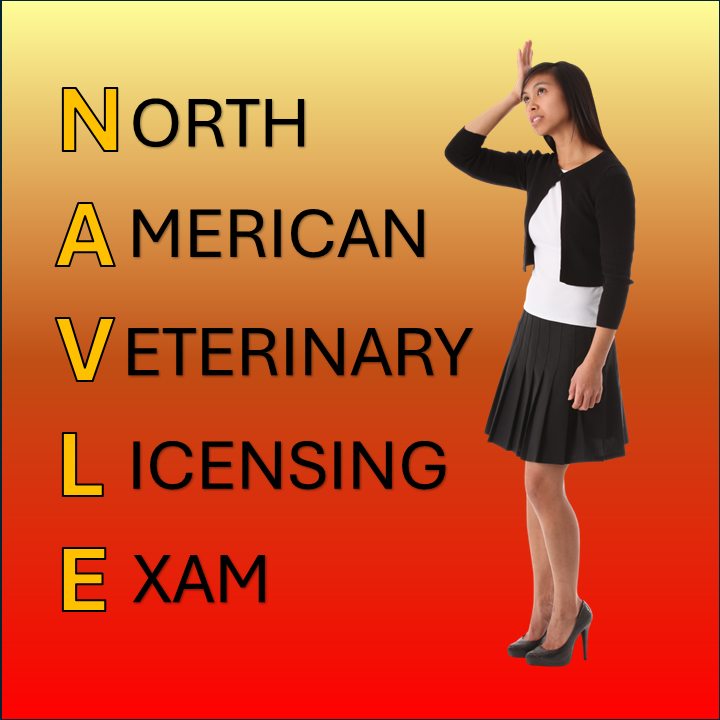
What is the NAVLE
The NAVLE is a veterinary licensing exam used in North America to determine whether or not a graduate of a veterinary program has the knowledge and practical skills it takes to practice as a veterinarian. At some point, graduates of accredited and unaccredited schools alike will need to write this test. Mind you, depending on your academic pathway it may not be the final stop before you get your license. In this article, I’m breaking down the basic information you need to know if you are planning to write the NAVLE, and what resources are available to help students.
Applying for the NAVLE
You might think that taking the NAVLE is the hardest part about the test. However, before one can even think of taking the NAVLE there are already hurdles to jump through. The test is administered by the ICVA or International Council for Veterinary Assessment. The test can be applied for online and is administered in two testing timeframes each of which has a different deadline for application. You can apply for the NAVLE either after graduation or in the final year before graduation of an AVMA (American Veterinary Medical Association) accredited school, or while finishing the ECFVG or PAVE pathways for unaccredited AVMA listed institutions. If you are a foreign graduate, and are taking the ECFVG or PAVE pathways you can apply in step three after taking the BCSE (Basic Clinical Sciences Exam) provided you are expecting to soon pass the CPE (Clinical Proficiency Exam). If you want to practice in Canada, bear in mind these pathways must be sought through the National Examining Board (NEB). After applying you will get an email with an ICVAID number with which you can start the process of scheduling your test as it allows you to access your permit to take the test. Yes, you actually need a special permit to take the test, print it and guard it with your life. Make absolutely sure that the names you provide them matches your government issued ID. Once you schedule your test and all fees are paid be absolutely sure you have your confirmation number.
What’s On the NAVLE
The NAVLE contains 300 questions that over the course of 7.5 hours, covers four broad categories of:
- Work Context
- Animal Species and Diagnosis
- Clinical and Professional Competency
- Foundational Sciences
It is important to sign up for updates on the ICVA website as they routinely update the information on what the NAVLE covers. They then further broadly classify these categories into Competencies and Diagnosis. Competencies covers everything from how to interact with clients to professionalism, to epidemiology, to welfare concerns. If you are a foreign graduate, studying this section is particularly relevant as not all countries consider the same things as welfare concerns. For example, in Norway it is illegal to neuter unnecessarily for welfare reasons, in Canada and the US desexing is highly recommended for both health and welfare reasons. The species and diagnosis category covers a range of diseases for each species covered in the test. Theses, you simply have to know inside and out, which is reasonable considering you presumably graduated from a veterinary program.
Studying for the Test
The NAVLE is not a test you can pull an all-nighter for and get away with it. Luckily the ICVA has many resources to help prepare you for the test, some of which are completely free! They provide sample questions on the website, which give you a good feel for the style of questioning. Are the sample questions enough? No, but they allow you to understand what kinds of things they may ask, and if you know that you can take the list of species and diagnosis they provide and make your own deck of sample questions. You can also purchase self-assessments on their site for under $100. They also have a NAVLE tutorial you can use, for free, to get used to how the computer test is administrated.
Don’t want to use the ICVA resources? There are external guides to the NAVLE as well. Such as the Mometrix NAVLE Secrets Study Guide, or Saunder’s Comprehensive Review. These can be purchased on a number of platforms, but there are also pdf versions of them floating around the internet. Mometrix also has a free practice test. Other great studying resources include books like the Merck or MSD Veterinary Manual which is available for free online where Merck (also called MSD) also publishes helpful quizzes for various topics. They aren’t targeted specifically for the NAVLE, but they’re an excellent resource for finding just about every disease, infection, and syndrome known to domestic animals. The Veterinary Workbook of Small Animal Clinical Cases, is also a great resource for scenario based learning, though bear in mind that the NAVLE covers more than just small animals.
For the competencies portion, if you are unsure of how countries like Canada and America view certain welfare issues or practices, two great resources are the AAHA and CVMA position statements. You can find the “official” opinions shall we say for free on their websites. The CVMA and NFACC develop “Codes of Practice” which represent the ideal standard of animal care in Canada. Not only are these helpful resources of information for the test, but they’re also things any vet practicing in Canada should be familiar with. How long do you study? Until you know all the subject matter like the back of your hand and can breeze through a practice test, in general people recommend 3 months.
Cost
How much does it cost to take the NAVLE? This will vary depending on where you take the test. If you take it within the US and Canada, as of the writing of this blog it costs $760 USD or $1025.13 CAD (exchange rate can vary), and if you want to take it outside the US and Canada tack on an extra $365. Also keep in mind that there are limited numbers of test centers. So depending on where you live testing may require that you drive a substantial distance and rent a hotel room if you’re planning to stay. If you have to travel any great distance to take your test, budget for the travel expenses and get yourself somewhere to sleep. You don’t want to show up to the test after a 10 hour drive or a long flight only to be exhausted for the next 7.5 hours.
So You’ve Passed the NAVLE What’s Next?
After the NAVLE you are not automatically issued a veterinary license. You have to apply to the state you wish to practice in, or if you’re in Ontario, Canada you must take the jurisprudence exam. Other provinces have their own requirements.
Conclusion
The NAVLE is one of many expensive and arduous hurtles a young veterinarian must pass before being permitted to practice. While it seems a particularly grueling challenge, not all veterinary schools are created equal and it is a necessary step to ensuring consistent and quality practice across North America. When will I start studying for the NAVLE? As a veterinary student in my first year, I already am.
Want More Content, Something Specific You Want to Hear?
Consider supporting me with a small donation on patreon, $1-2 would really help me out. Veterinary school is expensive, and researching and writing content takes time and effort. In exchange for your patronage, let me know what you want to hear about in the comments below, and I’ll do my best to cover it in my next blog. I appreciate all my readers, and I thank you for your continued support, donation or not. Thank you for visiting Petiscience.
 PetiScience