
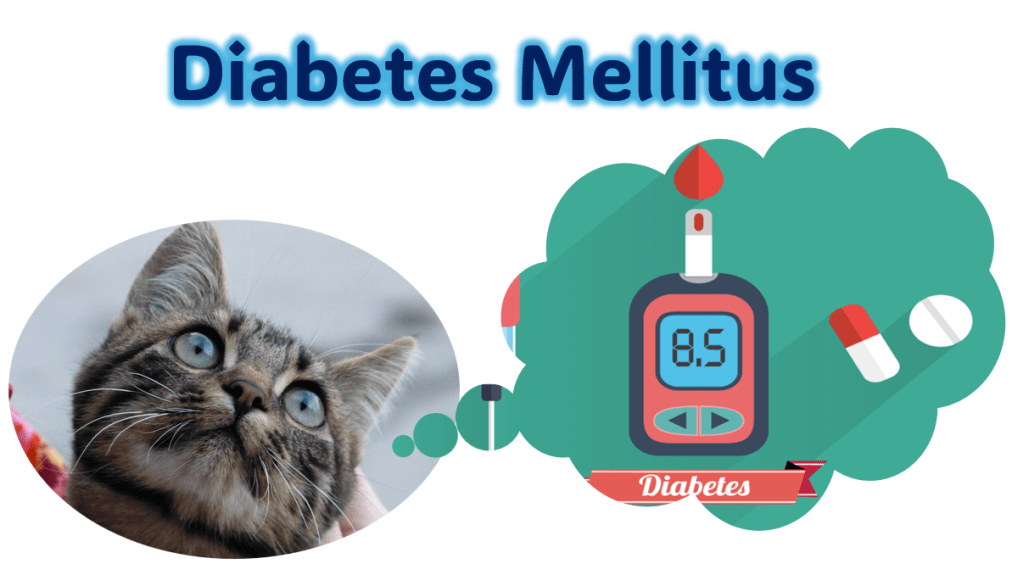
What is Diabetes?
Diabetes is a disease that affects ~3.1 million Americans, but did you know it also affects their pets? Indeed kitties and puppies of all nations may suffer from the disease. It general presents during midlife, and while treatable it is not curable (2). In essence, diabetes is a metabolic disease whereby the cells of the body cannot absorb the sugar glucose (2).
The Importance of Glucose and it’s Absorption
Glucose is needed for energy production!
Glucose, the basic sugar unit of most carbohydrates is normally absorbed into the bloodstream through the gut and transported to cells where specialized glucose transporter proteins or “GLUTs” for short, facilitate the absorption of glucose into individual cells (1, 2). Inside the cell the glucose goes through a pathway called glycolysis where it is sequentially split to produce energy in the form of adenosine triphosphate (ATP). There are several different varieties of these transporters in the body depending on the cell type. In mammals the most common glucose transporter is called GLUT4 and it’s function is dependent on the hormone insulin (1,2).
The Role of the Pancreas
The Pancreas Regulates glucose uptake through insulin signaling.
The pancreas is a lobulated organ that lies alongside the portion of the small intestine nearest the stomach, the duodenum (3). On the microscopic level it is made up of secretory cells called pancreatic acinar cells that secrete digestive enzymes which are passed through ducts to the small intestine (3). However it also has epithelial cell clusters referred to as the islets of Langerhans, or simply pancreatic islets that have endocrine function. These pancreatic islets can be subdivided into alpha and beta cells (2,3). Beta cells produce and secrete the hormone insulin, which is secreted into the bloodstream when glucose concentrations in the blood are high. When concentrations of glucose are low, the hormone glucagon secreted by alpha cells acts on glucose stores in the body known as glycogen, to promote release of glucose for use in the body (4,5).
Without insulin, the glucose transporter is not available for glucose transport.
Insulin acts by binding to a specialized insulin receptor on a cell’s membrane. The action of insulin binding to the insulin receptor triggers a quite complicated process of cell signaling activities the specific details of which are still not fully understood (4). The results is GLUT4 translocating to outer membrane of the cell and becoming available for glucose import (4). Thus without insulin, the GLUT4 glucose transporter stays inside the cell where it cannot transport glucose, leaving the cell to starve.
Causes of Diabetes
The causes of diabetes in animals are multifaceted and not fully understood. In general one of two situations occur. Either the animal’s pancreas becomes unable to produce insulin, leading to insulin deficiency, or the animal’s insulin receptors become resistant to insulin.
Not Enough Insulin
There are a few reasons why an animal may develop insulin insufficiency. In cases of severe pancreatitis, an inflammatory condition of the pancreas, the Islets of Langerhans may be destroyed, this usually occurs more often in dogs than cats (2). Cats may experience a condition called amyloidosis, in where an incorrectly folded protein called amyloid builds up in tissues and displaces normal cells, impairing pancreatic function. Amyloidosis can be hereditary and some breeds like Abyssinians are naturally predisposed (2). It is also possible for the immune system to incorrectly target the islets for destruction, leading to insulin insufficiency. No insulin, no glucose transport.
Insulin Resistance
In the other case, cells may develop resistance to insulin. In this case, there is plenty of insulin being produced by the pancreas, that isn’t the problem. If insulin acts as a messenger that tells the cell to take up glucose, in the case of insulin resistance, it is as if the messenger is talking to a brick wall. This can happen for a few reasons. If an animal is administered glucocorticoids or prostaglandins on a long -term basis they may develop insulin resistance (2,6). Progesterone produced in pregnancy has also been shown to cause insulin resistance in dogs, but not so much in cats (2). Interestingly, cats experiencing amyloidosis get a double whammy of both insulin resistance, and insulin insufficiency! Hypersomatotropism, a condition of excess growth hormone production can cause insulin resistance in cats, as can hypercortisolism, both of which can be caused by tumors of the pituitary gland. In the case of hypercortisolism; however, a tumor may be located either on the pituitary or the adrenal glands, or the condition can arise from chronic use of certain drugs (6,7).
Obesity
Much like in humans, obesity is known to be associated with increased diabetic risk in both dogs and cats (2,8). There are multiple proposed mechanisms for how this happens, many of which have to do with the long-term inflammatory effects of obesity resulting in damage to cell signaling pathways, as well as the pancreas, leading to insulin resistance and insufficiency (8).
Signs and Symptoms
Diabetes symptoms are important to watch out for but can sometimes be subtle. The most common symptoms are easily captured in what are referred to as the three P’s of diabetes.
- Polydipsia, Excessive Thirst: your animal may appear unusually thirsty, you may have to refill the water dish more often than normal. The average dog or cat should drink no more than 100 ml or so per kg of body weight in a single day. If your dog weights 10 kg, and drinks 2 liters of water a day, you should speak with your veterinarian. In diabetes, thirst is driven largely by increased water output, leading to the next sign of disease (2).
- Polyurea, Excessive Urination: you may notice your dog constantly asking for outings, stopping more often to pee, or your cat using the litter box more often. You may also notice unusual indoor accidents or bedwetting (2). This is due to to a disturbance in water balance. When glucose in the blood exceeds the capacity for reabsorption in the kidney, it is excreted into the filtrate that eventually becomes urine, and drags water along for the ride (3,9). This puts the body into a state of dehydration, causing excessive thirst.
- Polyphagia, Extreme Hunger. Diabetes is a disease where cells, deprived of their glucose begin to starve despite being surrounded by the very substance they crave, leading to the sensation of hunger despite high glucose levels (3,9).
You may also notice an animal with diabetes becoming physically weaker, due to cellular glucose deprivation. In the case of dogs, a specific glucose utilization pathway in the lens of the eye can lead to cataract formation (2,3). Weight loss may also be observed in animals with diabetes as the body tries to utilize it’s fat stores as an alternative energy source. If you smell your animal’s breath or urine it may give off a sweet odor (2).
Diagnosis
A veterinarian will diagnose diabetes by measuring the blood sugar levels of your animal with a simple blood test. A urine test can also help confirm the diagnosis as sugar is not normally present in the urine. Blood glucose should not exceed 75-120 mg/dL (2). However, stress can increase blood sugar levels, so if unsure several samples may be taken over time to confirm if the animal truly has diabetes or is simply stressed out. A fructosamine test can help confirm the difference. If you know anything about human diabetes, or if you yourself are diabetic, you have likely heard of a test called HbA1C done every 3 months or so. While HbA1C is not routinely performed in house pets with diabetes it serves a similar role to fructosamine testing in that it gives a blood sugar reading unaffected by stress (2). A pet with high glucose but normal fructosamine may simply be stressed out from being dragged to a vet office. But if an animal has high fructosamine, high blood glucose, and high urine glucose, it is fairly definitive. All efforts should also be made to determine if there is a cause to the animal’s diabetes such as a brain tumor or a drug regimen that predisposed the animal (2).
Management
Diabetes is regrettable in that it has no cure. While sometimes humans can manage their condition with weight reduction and careful dietary control, the same cannot be said for pets. Insulin injection is the standard course of therapy. Unfortunately, diabetes in dogs and cats does not respond the same way to alternative medications available for humans with the same condition.
Standard therapy involves insulin administration along with weight reduction diets that are specifically formulated to have low glycemic index. Common brands that make such diets are Hills and Royal Canin, but a non-veterinary formulated food can be used as well if it is formulated appropriately, though this is not ideal (2).
There are several types of insulin available. Usually a porcine or bovine insulin, or synthesized human insulin is given twice daily at feeding time. Meals are portioned, generally, into twice daily servings of equal caloric value (2). There are different types of insulin. Some are immediate and short acting, others intermediates, and some long-acting. An NPH-insulin (Neutral Protamine Hagedorn), is an intermediate-acting synthetically produced human insulin commonly used in dogs under the names Novo Nordisk or Novulin (13,14). “Lente” insulin, is a combination of generally bovine insulin, porcine insulin, and zinc and are still used in animal medicine but have fallen out of favor in human medicine, an example would be Caninsulin aka Vetsulin, licensed for use in dogs and cats (11). Prozinc, another common brand is a synthetic human insulin in zinc suspension is considered to be long-acting and is generally used more in cats than dogs but can be used for both (11,12). Detemir is a human synthetic insulin which is long acting and considered very effective in dogs (12). If a dog is not responding to Caninsulin or Prozinc, this may be the next step up, but it is highly potent so may be more likely than other insulins to result in accidental hypoglycemia if not closely monitored (2).
There are a small number of hypoglycemic agents available for oral treatment of diabetes in animals. Glipizide for instance, is used in cats to stimulate the remaining working beta cells to secrete insulin, but is insufficient in severe cases. Another medication called Acarbose may also be tried to lower blood glucose in combination with conventional insulin therapy in cats.
To prevent the animal from becoming hypoglycemic, a condition where blood sugar drops too low, blood glucose monitoring is needed. While working out a treatment plan for the specific animal at the early stages, glucose should be monitored sometimes multiple times a week. Once stable, monitoring should take place every 4-12 weeks. An owner should keep sugary substances such as honey, corn-syrup, glucose syrup, carob syrup, or maple syrup on hand in case the animal becomes hypoglycemic, which can lead to collapse, seizure and eventual coma and death (2,3). If an animal is hypoglycemic, it is recommended to administer small amounts of syrup according to your vet’s instructions. Use a spoon to tip some into the animal’s mouth, or if you trust your fingers not to be bitten, you can massage the syrup on it’s gums (2,14). Keep in mind that an animal that isn’t fully conscious, or that is sick, even if normally friendly, may bite your fingers while hypoglycemic. Be careful and consider your safety. It is possible to get bit, even by a dog or cat you’d trust with your life under the wrong circumstances. If you suspect your animal is having a hypoglycemic attack, always call your veterinarian even if you have performed first-aid.
This concludes this weeks article on diabetes mellitus. Curious about the information in this article, check the reference list below! All references correspond to the numbers listed in the article. Remember, a blog is never an appropriate substitute for an actual veterinarian.
This article is respectfully dedicated to Toby, a diabetic baby who passed away quietly from complications of diabetes mellitus two weeks ago. He will be missed. Click here to read his story.

The writing of this article utilized the following resources.
- Byers MS, Howard C, Wang X. Avian and Mammalian Facilitative Glucose Transporters. Microarrays (Basel). 2017 Apr 5;6(2):7. doi: 10.3390/microarrays6020007. PMID: 28379195; PMCID: PMC5487954.
- The Merck Veterinary Manual 11th Edition. Pgs. 579-583. The Pancreas, Diabetes Mellitus.
- Cunningham, Klein. The Textbook of Veterinary Physiology 4th Edition. Chapter 34, pgs 463-464.
- De Meyts P. The Insulin Receptor and Its Signal Transduction Network. [Updated 2016 Apr 27]. In: Feingold KR, Anawalt B, Blackman MR, et al., editors. Endotext [Internet]. South Dartmouth (MA): MDText.com, Inc.; 2000-. Available from: https://www.ncbi.nlm.nih.gov/books/NBK378978/
- Garzilli I, Itzkovitz S. Design principles of the paradoxical feedback between pancreatic alpha and beta cells. Sci Rep. 2018 Jul 16;8(1):10694. doi: 10.1038/s41598-018-29084-4. PMID: 30013127; PMCID: PMC6048053.
- Niessen SJM. Hypersomatotropism and Other Causes of Insulin Resistance in Cats. Vet Clin North Am Small Anim Pract. 2023 May;53(3):691-710. doi: 10.1016/j.cvsm.2023.02.005. Epub 2023 Mar 9. PMID: 36906467.
- https://www.ndsr.co.uk/insights/the-management-of-feline-hypersomatotropism-hs/
- Wondmkun YT. Obesity, Insulin Resistance, and Type 2 Diabetes: Associations and Therapeutic Implications. Diabetes Metab Syndr Obes. 2020 Oct 9;13:3611-3616. doi: 10.2147/DMSO.S275898. PMID: 33116712; PMCID: PMC7553667.
- Yeung AY, Tadi P. Physiology, Obesity Neurohormonal Appetite And Satiety Control. [Updated 2023 Jan 3]. In: StatPearls [Internet]. Treasure Island (FL): StatPearls Publishing; 2024 Jan-. Available from: https://www.ncbi.nlm.nih.gov/books/NBK555906/
- https://www.fda.gov/animal-veterinary/cvm-updates/fda-approves-first-oral-treatment-cats-diabetes-mellitus
- Deckert T. Intermediate-acting insulin preparations: NPH and lente. Diabetes Care. 1980 Sep-Oct;3(5):623-6. doi: 10.2337/diacare.3.5.623. PMID: 7192205.
- https://www.petmd.com/pet-medication/insulin-dogs-and-cats
- Saleem F, Sharma A. NPH Insulin. [Updated 2023 Jun 12]. In: StatPearls [Internet]. Treasure Island (FL): StatPearls Publishing; 2024 Jan-. Available from: https://www.ncbi.nlm.nih.gov/books/NBK549860/
- https://www.aaha.org/aaha-guidelines/diabetes-management/treatment/insulin-therapies/#:~:text=PZI%20(U%2D40%20human%20recombinant,use%20in%20cats%20and%20dogs.
 PetiScience